The comet has decreased to 3rd magnitude and supposedly someone said it has lost its color evenwhile it has grown in size (to our Sun). In the sky, this translates to the size of the moon higher in the sky. I will post more of my photos tomorrow. Meanwhile latest news on Hubble spying the comet
HUBBLE ZOOMS IN ON HEART OF MYSTERIOUS COMET HOLMES
---------------------------------------------------
NASA's Hubble Space Telescope has probed the bright core of Comet
17P/Holmes, which, to the delight of sky watchers, mysteriously brightened
by nearly a millionfold in a 24-hour period last month.
http://spaceflightnow.com/news/n0711/15cometholmes/
Tuesday, November 20, 2007


Monday, November 19, 2007
onight comet Holmes is in front of several stars.
Tonight comet Holmes is in front of several stars. Comet Holmes large fragment broke off and disintegrated into tiny dust particles which scattered to create the bubble we see. Catch the comet this week before full moon. Information suggest that the comet bubble cloud will expand in weeks (and months?) but will grow fainter as it continues to expand.
I will try to post more of my pics tomorrow.
more info at
Comet Holmes Now Bigger Than the Sun
Friday, November 16, 2007
By Robert Roy Britt
"The offset nature of the coma, seen in ground-based images, suggests "a large fragment broke off and subsequently disintegrated into tiny dust particles after moving away from the main nucleus," Hubble astronomers said in a statement Thursday."
http://www.foxnews.com/story/0,2933,311868,00.html
I will try to post more of my pics tomorrow.
more info at
Comet Holmes Now Bigger Than the Sun
Friday, November 16, 2007
By Robert Roy Britt
"The offset nature of the coma, seen in ground-based images, suggests "a large fragment broke off and subsequently disintegrated into tiny dust particles after moving away from the main nucleus," Hubble astronomers said in a statement Thursday."
http://www.foxnews.com/story/0,2933,311868,00.html
Saturday, November 17, 2007
Leonid Meteor shower Sunday 11/18 morning
The famous Leonid meteor shower will appear this Sunday morning.
Look for meteors streaming out from the sickle in the constellation Leo s it rises from the NE.
This will not be a great year as the Earth will not hit the major meteoric parts of the stream but it is supposed to be better in Asia.
You may see some bright ones however with trails called "trains."
I will post what I see. If anyone takes photos or see some good fireballs let me know .
Look for meteors streaming out from the sickle in the constellation Leo s it rises from the NE.
This will not be a great year as the Earth will not hit the major meteoric parts of the stream but it is supposed to be better in Asia.
You may see some bright ones however with trails called "trains."
I will post what I see. If anyone takes photos or see some good fireballs let me know .
Wednesday, November 14, 2007
My latest picture of CometHolmes Bubble

60 exposure to highlight outer bubble.That over exposes the inner part though.
Map to find the Comet see it below.

Saturday, November 10, 2007
It has been about 2 weeks when the comet Holmes erupted.

It has been about 2 weeks when the comet Holmes erupted. Finally I have some pics of several to post. Taken on 11/04/07 are 5 of my pictures taken in collage style of the surprising comet Holmes.
all 8 seconds long exp.
Top left with red filter
Top- right with green filter
Bottom- left with blue filter
Bottom- right with infra red filter
center - clear filter
Holmes amazing its tranformation and links to pics and more
First it was amazing what this comet did by exploding and zooming from 17 to magnitude 2.5 in a very short time (1 million times in brightness increase it was said).
Second it is amazing that this comet show has lasted so long as I thought it would fade away quite rapidly and not put on such a show for this length of time.
It has been a lot of fun to watch, observe and photograph.
There was another article in the Kansas City star recently from another AP press article entitled " Comet Explodes , interest booms," from a Knoxville, TN source and photo. So it is really good that our newspaper and now other are posting and telling people about this comet. I can't say the same for the inability of the press to post information about the Great Comet McNaught in January before it went too close to the sun and went below the equator.( We only had four good days after sunset to look and the comet though bright was more difficult to see as it was low on the horizon but still....)
The beautiful photo of Holmes and its fan tail
http://antwrp.gsfc.nasa.gov/apod/ap071110.html
***
another beautiful photo in Apod of Comet Holmes with the tail at
http://antwrp.gsfc.nasa.gov/apod/ap071105.html
I received more information about its creation from the author (see the following below- with other links below that)
*
Hello,
thank you very much for all of your compliments and congratulations!
I got to much mails, contacting each of you.
The photo of comet Holmes is an average of 42 single shots (each 1 min) taken with an ccd camera ST 2000XM. For processing I used CCD-Soft, RegiStax and Photoshop (for individual masks)
Optic: 600mm f/6
Best regards
Sebastian Voltmer
***
Meanwhile comet expansion animation at
http://antwrp.gsfc.nasa.gov/apod/ap071030.html
***
Holmes shell expansion
http://antwrp.gsfc.nasa.gov/apod/ap071103.html
**
Golden color photo
http://antwrp.gsfc.nasa.gov/apod/ap071029.html
**
first good look and report
http://antwrp.gsfc.nasa.gov/apod/ap071026.html
***
Nov 10 (if not seen that day look in archives)
http://www.spaceweather.com/
also more
(1) another nice photo of the tail of Holmes splitting off,
(2) good information about a theory about what made the brightness eruptions and
and this very cool
(3) if you have 3 D red and blue glasses
a 3d photo of the comet
***
Dr. Eric Flescher (kcstarguy@aol.com), Olathe, KS: Lat 38.834, Lon -94.778: Comet Observers Award Coordinator- Astronomical League / Astronomical Society of Kansas, KC, MO-Louisburg,KS: http://www.astroleague.org/al/obsclubs/comet/comet.htm: Subscribe to (send your email to):CometObserversAwardAL-subscribe@yahoogroups.com : : Eclipse sightings > http://eclipse-sightings.blogspot.com/: E.O.A.S. (Earth, Oceans, Atmosphere and Space) Blog -
Friday, November 9, 2007
Hailstorm
Nice photos of hailstorms result spanish speaking country. Look at the size of the hailstones and the damage holes in buildings.
Monday, November 5, 2007
My photo collage of comet Holmes
It has been about 2 weeks when the comet erupted. Finally I have some pics of several to post. Taken on 11/04/07 are 5 of my pictures taken in collage style of the surprising comet Holmes.
all 8 seconds long exp.
Top left with red filter
Top- right with green filter
Bottom- left with blue filter
Bottom- right with infra red filter
center - clear filter
Holmes amazing its tranformation and links to pics and more
First it was amazing what this comet did by exploding and zooming from 17 to magnitude 2.5 in a very short time.
Second it is amazing that this comet show has lasted so long as I thought it would fade away quite rapidly and not put on such a show for this length of time.
It has been a lot of fun to watch, observe and photograph.
There was another article in the Kansas City star recently from another AP press article entitled " Comet Explodes , interest booms," from a Knoville, TN source and photo. So it is really good that our newspaper and now other are posting and telling people about this comet. I can't say the same for the inability of the press to post information about Comet McNaught in January before it went too close to the sun and went below the equator.
The beautiful photo of Holmes and its fan tail
http://antwrp.gsfc.nasa.gov/apod/ap071110.html
***
another beautiful photo in Apod of Comet Holmes with the tail at
http://antwrp.gsfc.nasa.gov/apod/ap071105.html
I received more information about its creation from the author (see the following below- with other links below that)
*
Hello,
thank you very much for all of your compliments and congratulations!
I got to much mails, contacting each of you.
The photo of comet Holmes is an average of 42 single shots (each 1 min) taken with an ccd camera ST 2000XM. For processing I used CCD-Soft, RegiStax and Photoshop (for individual masks)
Optic: 600mm f/6
Best regards
Sebastian Voltmer
***
Meanwhile comet expansion animation at
http://antwrp.gsfc.nasa.gov/apod/ap071030.html
***
Holmes shell expansion
http://antwrp.gsfc.nasa.gov/apod/ap071103.html
**
Golden color photo
http://antwrp.gsfc.nasa.gov/apod/ap071029.html
**
first good look and report
http://antwrp.gsfc.nasa.gov/apod/ap071026.html
Dr. Eric Flescher (kcstarguy@aol.com), Olathe, KS: Lat 38.834, Lon -94.778: Comet Observers Award Coordinator- Astronomical League / Astronomical Society of Kansas, KC, MO-Louisburg,KS: http://www.astroleague.org/al/obsclubs/comet/comet.htm: Subscribe to (send your email to):CometObserversAwardAL-subscribe@yahoogroups.com : : Eclipse sightings > http://eclipse-sightings.blogspot.com/: E.O.A.S. (Earth, Oceans, Atmosphere and Space) Blog -
Sunday, October 28, 2007
Fires from Space
These winds comet every year. The people know its coming. All it takes is a spark. Fires from space as seen. I wonder why the people don't try a little preventive measures before the fact?
Friday, October 26, 2007
lightning: don't take a leak, clean your teeth or jog with ipod
Incredible news items about weather and lightning
Which do you find most incredible and why?
(1) , (2) or (3)
**
Biker's penis hit by lightning
http://www.news.com.au/story/0,23599,22478688-23109,00.html
By staff writers
September 25, 2007 11:12am
Article from:
Font size: + -
Send this article: Print Email
AN Croatian motorbike rider was knocked unconscious when lightning struck his penis during a roadside toilet break.
Metro.co.uk reported Ante Djindjic, 29, escaped relatively unscathed from the incident, suffering only light burns to his chest and arms.
He said: "I don't remember what happened. One minute I was taking a leak and the next thing I knew I was in hospital.
"Doctors said the lightning went through my body and because I was wearing rubber boots it earthed itself through my penis."
"Thankfully, the doctors said that there would be no lasting effects, and my penis will function normally eventually."
That's just as long as lightning doesn't stike in the same place twice.
**
Lightning exits from woman's bum
A Croatian woman was left with a severely burned anus after a lightning strike which entered through her mouth left her body through her bottom. picked by mitzuzake 2 weeks ago
Lightning exits from woman's bum
Tuesday, October 10, 2006
What Natasha Timarovic's bottom may have looked like
A Croatian woman was left with a severely burned anus after a lightning strike which entered through her mouth left her body through her bottom.
The lightning reportedly struck Natasha Timarovic's building as she was cleaning her teeth – with her mouth to the tap, sending the current through her body.
And as she was wearing rubber-soled shoes, the lightning bolt was unable to earth through her feet – so it took the next easiest route, and came out of her rectum.
It then earthed itself via her moist shower curtain.
'It was incredibly painful, I felt it pass through my torso and then I don't remember much at all,' Timarovic said.
A medic told local news station 24 Sata: 'Instead of earthing through her feet, it appears the electricity shot out of her backside… if she had not been wearing the shoes she would probably have been killed.'
The medic described the incident as 'bizarre, but not impossible.'
http://www.metro.co.uk/weird/article.html?in_article_id=20883
**
A Jogger Wearing iPod Struck by Lightning
A man wearing his iPod during a thunderstorm was hurled eight feet into the air when lightning hit a tree close by. The 37-year-old Canadian jogger was taken to a Vancouver hospital with burned parts of body, blown-out eardrums and fracture of a lower jaw. The burns covering the man's chest, neck and ear coincided with the positions of his iPod earphones he was wearing at the moment of the lightning strike.
http://www.infoniac.com/offbeat-news/a-jogger-wearing-ipod-struck-by-lightning.html
Which do you find most incredible and why?
(1) , (2) or (3)
**
Biker's penis hit by lightning
http://www.news.com.au/story/0,23599,22478688-23109,00.html
By staff writers
September 25, 2007 11:12am
Article from:
Font size: + -
Send this article: Print Email
AN Croatian motorbike rider was knocked unconscious when lightning struck his penis during a roadside toilet break.
Metro.co.uk reported Ante Djindjic, 29, escaped relatively unscathed from the incident, suffering only light burns to his chest and arms.
He said: "I don't remember what happened. One minute I was taking a leak and the next thing I knew I was in hospital.
"Doctors said the lightning went through my body and because I was wearing rubber boots it earthed itself through my penis."
"Thankfully, the doctors said that there would be no lasting effects, and my penis will function normally eventually."
That's just as long as lightning doesn't stike in the same place twice.
**
Lightning exits from woman's bum
A Croatian woman was left with a severely burned anus after a lightning strike which entered through her mouth left her body through her bottom. picked by mitzuzake 2 weeks ago
Lightning exits from woman's bum
Tuesday, October 10, 2006
What Natasha Timarovic's bottom may have looked like
A Croatian woman was left with a severely burned anus after a lightning strike which entered through her mouth left her body through her bottom.
The lightning reportedly struck Natasha Timarovic's building as she was cleaning her teeth – with her mouth to the tap, sending the current through her body.
And as she was wearing rubber-soled shoes, the lightning bolt was unable to earth through her feet – so it took the next easiest route, and came out of her rectum.
It then earthed itself via her moist shower curtain.
'It was incredibly painful, I felt it pass through my torso and then I don't remember much at all,' Timarovic said.
A medic told local news station 24 Sata: 'Instead of earthing through her feet, it appears the electricity shot out of her backside… if she had not been wearing the shoes she would probably have been killed.'
The medic described the incident as 'bizarre, but not impossible.'
http://www.metro.co.uk/weird/article.html?in_article_id=20883
**
A Jogger Wearing iPod Struck by Lightning
A man wearing his iPod during a thunderstorm was hurled eight feet into the air when lightning hit a tree close by. The 37-year-old Canadian jogger was taken to a Vancouver hospital with burned parts of body, blown-out eardrums and fracture of a lower jaw. The burns covering the man's chest, neck and ear coincided with the positions of his iPod earphones he was wearing at the moment of the lightning strike.
http://www.infoniac.com/offbeat-news/a-jogger-wearing-ipod-struck-by-lightning.html
Wednesday, October 24, 2007
Comet 17P/Holmes brightens 500000 times to reach mag 2.5
Another unexpected surprise for a comet. Comet Holmes has brightened to 2.5 magnitude while over Europe. It is Perseus in the Northeast sky as the constellation rises tonight.
The moon is hindering the process with filmy clouds here in Kansas but I think I see it .
It is on a line from the brightest star in Perseus (called ) and yellow Capella (brightest star in Auriga). It is .25 way down (to Capella ) and to the left.
Catch it as who knows how long this outburst will last.
Space Weather News for Oct. 24, 2007
http://spaceweather.com
ERUPTING COMET: Astronomers in Japan and Europe report that Comet 17P/Holmes is undergoing a spectacular eruption. The 17th-magnitude comet has brightened by a factor of five hundred thousand or more during the past 24 hours becoming a naked eye object in the evening sky. This may signify a breakup of the comet's core or a rich vein of ice suddenly exposed to sunlight--no one knows. Look for a yellow 2.5th-magnitude fuzzball in the constellation Perseus after sunset. ("2.5th magnitude" means a little dimmer than the stars of the Big Dipper.) At present the comet looks more like a star than a comet; it does not have a discernable tail, but it might grow one as the outburst continues. Visit http://spaceweather.com for a sky map, photos and updates.
The moon is hindering the process with filmy clouds here in Kansas but I think I see it .
It is on a line from the brightest star in Perseus (called ) and yellow Capella (brightest star in Auriga). It is .25 way down (to Capella ) and to the left.
Catch it as who knows how long this outburst will last.
Space Weather News for Oct. 24, 2007
http://spaceweather.com
ERUPTING COMET: Astronomers in Japan and Europe report that Comet 17P/Holmes is undergoing a spectacular eruption. The 17th-magnitude comet has brightened by a factor of five hundred thousand or more during the past 24 hours becoming a naked eye object in the evening sky. This may signify a breakup of the comet's core or a rich vein of ice suddenly exposed to sunlight--no one knows. Look for a yellow 2.5th-magnitude fuzzball in the constellation Perseus after sunset. ("2.5th magnitude" means a little dimmer than the stars of the Big Dipper.) At present the comet looks more like a star than a comet; it does not have a discernable tail, but it might grow one as the outburst continues. Visit http://spaceweather.com for a sky map, photos and updates.
Tuesday, October 23, 2007
It's too bad the Moon is at the same distance each month
If the moon was the same distance (at new Moon time ) each month and traveled in the same area, we would have total solar eclipses each month. But since the Moon traveles differently we experience a total solar eclipse only rarely. In example of how this works is this months Full moon.
10/23/2007
BIG FULL MOON: This week's full Moon is the biggest full Moon of 2007. It's no illusion. Some full Moons are genuinely larger than others and Thursday night's will be a whopper. Why? Read the answer below.
http://www.spaceweather.com/
10/23/2007
BIG FULL MOON: This week's full Moon is the biggest full Moon of 2007. It's no illusion. Some full Moons are genuinely larger than others and Thursday night's will be a whopper. Why? Read the answer below.
http://www.spaceweather.com/
Monday, October 22, 2007
More teachers in space finally
NASA halted the TIS program after the Challenger disaster. Politicians and other were able to go aboard and take a ride and that rip. Barbara Morgan finally got the chance after 20 something years. Now more will be going.
Space
http://www.chron.com/disp/story.mpl/space/5234228.html
Oct. 22, 2007, 9:59AM
2 teacher-astronauts assigned to 2008 mission
By MARK CARREAU
Copyright 2007 Houston Chronicle TOOLS
CAPE CANAVERAL, Fla. -- Two more of NASA's classroom teachers turned astronauts have been assigned to their first spaceflights.
Ricky Arnold and Joe Acaba, who left teaching posts three years ago to join NASA's astronaut corps, are among seven astronauts assigned to the same assembly mission to the international space station. Scheduled for the fall of 2008, the mission will deliver the last of four solar power modules to the orbital outpost.
Their assignment, announced on Friday, comes of the heels of NASA astronaut Barbara Morgan's August shuttle flight. Morgan, who served as the backup to NASA's teacher-in-space Christa McAuliffe, flew after a 21-year wait. McAuliffe was among seven astronauts that perhished in the 1986 Challenger explosion.
Morgan,who resumed her teaching duties in McCall, Idaho, after the tragedy, was invited by NASA to train as a professional astronaut in 1998. A half-dozen years later, the space agency selected three more teachers to train for spaceflight.
Acaba joined the space agency after five years of teaching high school and middle school math and science in Florida.
Arnold was selected for astronaut training after teaching math and science in Romania, Indonesia, Saudi Arabia and Morocco.
Astronaut Dorothy Metcalf-Lindenburger, who joined NASA's astronaut corps as a high school astronomy and science instructor in Vancouver, Wash., awaits her first spaceflight assignment.
Space
http://www.chron.com/disp/story.mpl/space/5234228.html
Oct. 22, 2007, 9:59AM
2 teacher-astronauts assigned to 2008 mission
By MARK CARREAU
Copyright 2007 Houston Chronicle TOOLS
CAPE CANAVERAL, Fla. -- Two more of NASA's classroom teachers turned astronauts have been assigned to their first spaceflights.
Ricky Arnold and Joe Acaba, who left teaching posts three years ago to join NASA's astronaut corps, are among seven astronauts assigned to the same assembly mission to the international space station. Scheduled for the fall of 2008, the mission will deliver the last of four solar power modules to the orbital outpost.
Their assignment, announced on Friday, comes of the heels of NASA astronaut Barbara Morgan's August shuttle flight. Morgan, who served as the backup to NASA's teacher-in-space Christa McAuliffe, flew after a 21-year wait. McAuliffe was among seven astronauts that perhished in the 1986 Challenger explosion.
Morgan,who resumed her teaching duties in McCall, Idaho, after the tragedy, was invited by NASA to train as a professional astronaut in 1998. A half-dozen years later, the space agency selected three more teachers to train for spaceflight.
Acaba joined the space agency after five years of teaching high school and middle school math and science in Florida.
Arnold was selected for astronaut training after teaching math and science in Romania, Indonesia, Saudi Arabia and Morocco.
Astronaut Dorothy Metcalf-Lindenburger, who joined NASA's astronaut corps as a high school astronomy and science instructor in Vancouver, Wash., awaits her first spaceflight assignment.
Sunday, October 21, 2007
The Orionids (October) and May Aquarids have meteor showers produced from the trails of Halley's Comet.
by Dr.Eric Flescher (kcstarguy@aol.com)
The Orionids (October) and May Aquarids have meteor showers produced from the trails of Halley's Comet.
I have not observed Orionids in many years. Of course I missed the outburst in 2006. But I decided to try just in case another
outburst came about. Not much of show for 2 hours worth of week on 2 nights. I would have stayed out longer but
I did see 2 fireballs on Friday. Overall they were bland in color, no trails and were
brigher then expected.
No meteors on the photos though. Better luck with Leonids.
date 10/20/07
location Olathe, KS
weather clear
visibility: 5.5
S-sporadic
O-Orionid length
time color degrees magnitude duration
3:55 O white 3 2 0.5
4:27 blue 7 3 0.5
4:29 O white 5 2 0.5
4:36 O white yellow 20 -2 0.75
4:51 O white 10 -2 0.75
date 10/21/07
location Olathe, KS
weather 10% light clouds4:17-5
visibility: 5 hazy
4:12 O white 10 0 0.5
4:17 O white 6 2 0.5
4:17 O white 10 0 0.5
4:21 O white 3 1 0.5
4:34 O white 5 1 0.5
additional: no train - trails
rates down from burst in 2006
http://www.spaceweather.com/meteors/gallery_21oct06.htm
The Orionids (October) and May Aquarids have meteor showers produced from the trails of Halley's Comet.
I have not observed Orionids in many years. Of course I missed the outburst in 2006. But I decided to try just in case another
outburst came about. Not much of show for 2 hours worth of week on 2 nights. I would have stayed out longer but
I did see 2 fireballs on Friday. Overall they were bland in color, no trails and were
brigher then expected.
No meteors on the photos though. Better luck with Leonids.
date 10/20/07
location Olathe, KS
weather clear
visibility: 5.5
S-sporadic
O-Orionid length
time color degrees magnitude duration
3:55 O white 3 2 0.5
4:27 blue 7 3 0.5
4:29 O white 5 2 0.5
4:36 O white yellow 20 -2 0.75
4:51 O white 10 -2 0.75
date 10/21/07
location Olathe, KS
weather 10% light clouds4:17-5
visibility: 5 hazy
4:12 O white 10 0 0.5
4:17 O white 6 2 0.5
4:17 O white 10 0 0.5
4:21 O white 3 1 0.5
4:34 O white 5 1 0.5
additional: no train - trails
rates down from burst in 2006
http://www.spaceweather.com/meteors/gallery_21oct06.htm
The Orionids (October) and May Aquarids have meteor showers produced from the trails of Halley's Comet.
by Dr.Eric Flescher (kcstarguy@aol.com)
The Orionids (October) and May Aquarids have meteor showers produced from the trails of Halley's Comet.
I have not observed Orionids in many years. Of course I missed the outburst in 2006. But I decided to try just in case another
outburst came about. Not much of show for 2 hours worth of week on 2 nights. I would have stayed out longer but
I did see 2 fireballs on Friday. Overall they were bland in color, no trails and were
brigher then expected.
No meteors on the photos though. Better luck with Leonids.
date 10/20/07
location Olathe, KS
weather clear
visibility: 5.5
S-sporadic
O-Orionid length
time color degrees magnitude duration
3:55 O white 3 2 0.5
4:27 blue 7 3 0.5
4:29 O white 5 2 0.5
4:36 O white yellow 20 -2 0.75
4:51 O white 10 -2 0.75
date 10/21/07
location Olathe, KS
weather 10% light clouds4:17-5
visibility: 5 hazy
4:12 O white 10 0 0.5
4:17 O white 6 2 0.5
4:17 O white 10 0 0.5
4:21 O white 3 1 0.5
4:34 O white 5 1 0.5
additional: no train - trails
rates down from burst in 2006
http://www.spaceweather.com/meteors/gallery_21oct06.htm
The Orionids (October) and May Aquarids have meteor showers produced from the trails of Halley's Comet.
I have not observed Orionids in many years. Of course I missed the outburst in 2006. But I decided to try just in case another
outburst came about. Not much of show for 2 hours worth of week on 2 nights. I would have stayed out longer but
I did see 2 fireballs on Friday. Overall they were bland in color, no trails and were
brigher then expected.
No meteors on the photos though. Better luck with Leonids.
date 10/20/07
location Olathe, KS
weather clear
visibility: 5.5
S-sporadic
O-Orionid length
time color degrees magnitude duration
3:55 O white 3 2 0.5
4:27 blue 7 3 0.5
4:29 O white 5 2 0.5
4:36 O white yellow 20 -2 0.75
4:51 O white 10 -2 0.75
date 10/21/07
location Olathe, KS
weather 10% light clouds4:17-5
visibility: 5 hazy
4:12 O white 10 0 0.5
4:17 O white 6 2 0.5
4:17 O white 10 0 0.5
4:21 O white 3 1 0.5
4:34 O white 5 1 0.5
additional: no train - trails
rates down from burst in 2006
http://www.spaceweather.com/meteors/gallery_21oct06.htm
Comet LONEOS (C/2007 F1) is still difficult to see
amateur astronomers , comet hunters and potential comet observer awardees
I'd like to see more people trying for our two comet awards. You must be a member of the Astronomical League or a member of a club that has an affiliation to AL.
With the silver award you get a great looking comet award pin and an award certificate suitable for framing.
pin example
http://members.aol.com/kcstarguy/satoriastronomy/cometaward.htm
Both the silver and gold certificates include beautiful photos of Comet Hal Bopp and Hayutake ( they were graciously provided by the late ASKC member Vic Winters).
I have tried 3 times but have not observed or photographed this supriseing new Comet Loneos.
There are 3 thing reasons Comet Loneos is difficult to view and photograph:
(1) Instead of rising higher in the sky Comet Loneos is going parallel to the horizon. Eventhough it is near south of Arcturus and below still difficult.
(2) eventhough it is around magnitude 6 and may rise to 4, it sets soon after sunset.
(3) the greenish color makes it difficult to view in the starry background compared to like Comet McNaught last January which was gold-white.
Close approach is in a few days. Keep watching and trying.
New pics on spaceweather my friend Tunc from Turkey (great eclipse photographer too).
Keep watching spaceweather, Apod and try to catch it yourself.
If others find it, let me know and cirumstances.
if you can see or photograph this one, you can add it to the 10 comet observations.
Remember 2 can be before 1/1/2001.
Observations and data of 12 for the silver award can be either regular photos, ccd pictures of sketches.
To see a sample of my silver award page and 3 examples, see
http://members.aol.com/kcstarguy/satoriastronomy/cometaward.htm
? let me know
Dr. Eric Flescher (kcstarguy@aol.com), Olathe, KS Comet Observers Award Coordinator- Astronomy League/ Astronomical Society of Kansas, KC, MO-Louisburg,KS: http://www.astroleague.org/al/obsclubs/comet/comet.htm: Subscribe to (send your email to):CometObserversAwardAL-subscribe@yahoogroups.com
**
Sometimes are predicatable and appear on a regular schedule. Some like Comet McNaught last January surprised us from out of the "blue." Here is another new mystery comet. Catch it while you can and if you can
http://www.spaceweather.com/swpod2007/20oct07/pmheden1.jpgob.
It's Comet LONEOS (C/2007 F1).
10/26/07
Last night in Turkey, Tunç Tezel tried the procedure and was rewarded as follows:
Photo details: Canon EOS 5D, 400 mm lens, f/5.6, ISO 3200, 30s.
The bush in the foreground highlights one problem with this pretty green comet: it is very close to the horizon and sets soon after nightfall. This makes the comet a potentially challenging target.
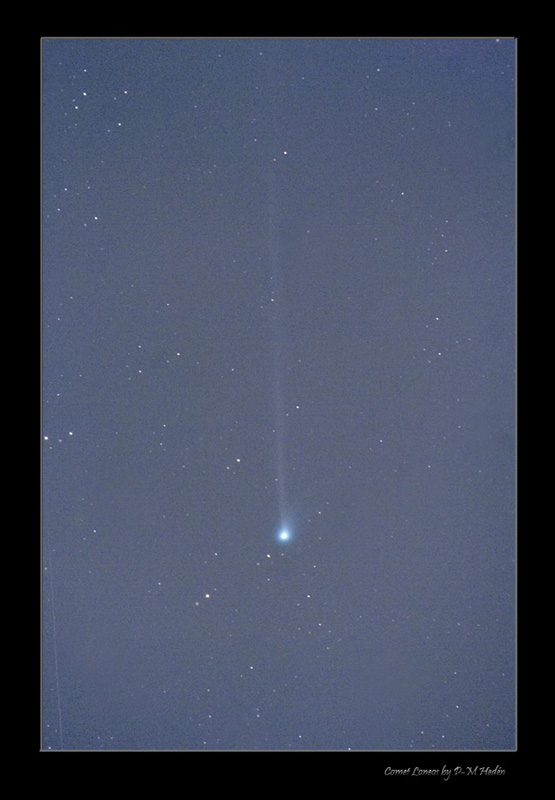
A backyard telescope reveals much more than a camera alone. P-M Hedén of Vallentuna, Sweden, took this picture
http://www.spaceweather.com/swpod2007/20oct07/pmheden1.jpg
on October 18th using his 3-inch refractor. "This is a very nice comet," he says. "I estimate its magnitude as +6.5." Comet LONEOS will brighten further perhaps to 4th magnitude on Oct 29th when it approaches the sun almost as close as the planet Mercury. Stay tuned for updates.
more images: from Peter Heinzen near Raron, Switzerland
LONEOS links: sky map, ephemeris, 3D orbit
I'd like to see more people trying for our two comet awards. You must be a member of the Astronomical League or a member of a club that has an affiliation to AL.
With the silver award you get a great looking comet award pin and an award certificate suitable for framing.
pin example
http://members.aol.com/kcstarguy/satoriastronomy/cometaward.htm
Both the silver and gold certificates include beautiful photos of Comet Hal Bopp and Hayutake ( they were graciously provided by the late ASKC member Vic Winters).
I have tried 3 times but have not observed or photographed this supriseing new Comet Loneos.
There are 3 thing reasons Comet Loneos is difficult to view and photograph:
(1) Instead of rising higher in the sky Comet Loneos is going parallel to the horizon. Eventhough it is near south of Arcturus and below still difficult.
(2) eventhough it is around magnitude 6 and may rise to 4, it sets soon after sunset.
(3) the greenish color makes it difficult to view in the starry background compared to like Comet McNaught last January which was gold-white.
Close approach is in a few days. Keep watching and trying.
New pics on spaceweather my friend Tunc from Turkey (great eclipse photographer too).
Keep watching spaceweather, Apod and try to catch it yourself.
If others find it, let me know and cirumstances.
if you can see or photograph this one, you can add it to the 10 comet observations.
Remember 2 can be before 1/1/2001.
Observations and data of 12 for the silver award can be either regular photos, ccd pictures of sketches.
To see a sample of my silver award page and 3 examples, see
http://members.aol.com/kcstarguy/satoriastronomy/cometaward.htm
? let me know
Dr. Eric Flescher (kcstarguy@aol.com), Olathe, KS Comet Observers Award Coordinator- Astronomy League/ Astronomical Society of Kansas, KC, MO-Louisburg,KS: http://www.astroleague.org/al/obsclubs/comet/comet.htm: Subscribe to (send your email to):CometObserversAwardAL-subscribe@yahoogroups.com
**
Sometimes are predicatable and appear on a regular schedule. Some like Comet McNaught last January surprised us from out of the "blue." Here is another new mystery comet. Catch it while you can and if you can
http://www.spaceweather.com/swpod2007/20oct07/pmheden1.jpgob.
It's Comet LONEOS (C/2007 F1).
10/26/07
Last night in Turkey, Tunç Tezel tried the procedure and was rewarded as follows:
Photo details: Canon EOS 5D, 400 mm lens, f/5.6, ISO 3200, 30s.
The bush in the foreground highlights one problem with this pretty green comet: it is very close to the horizon and sets soon after nightfall. This makes the comet a potentially challenging target.
A backyard telescope reveals much more than a camera alone. P-M Hedén of Vallentuna, Sweden, took this picture
http://www.spaceweather.com/swpod2007/20oct07/pmheden1.jpg
on October 18th using his 3-inch refractor. "This is a very nice comet," he says. "I estimate its magnitude as +6.5." Comet LONEOS will brighten further perhaps to 4th magnitude on Oct 29th when it approaches the sun almost as close as the planet Mercury. Stay tuned for updates.
more images: from Peter Heinzen near Raron, Switzerland
LONEOS links: sky map, ephemeris, 3D orbit
Saturday, October 20, 2007
Going to Titan take an umbrella
Scientists new Saturn's moon Titan was different. Close inspection showed we could not see the surface due to orange layer around it. The Cassini probe that landed a probe on its surface revealed more.
Saturday, October 13, 2007
new comet LONEOS is getting brighter but still difficult to see
This new comet is getting brighter but still difficult to see as it is so close to the horizon (I have not seen it yet but when I do I will post a pic)
Meanwhile here nice animation of the current 8th magnitude COMET LONEOS
http://spaceweather.com
10/13/2007 (if not this date go to archives)
COMET LONEOS: Comet LONEOS (C/2007 F1) is plunging toward the sun and solar heating is doing its work: pieces of the 8th-magnitude comet are boiling off. "We were surprised to see blobs moving in the tail," report Filipe Alves, Jan Lameer and Jose Ribeiro at the AstroQueyras Observatory in the French Alps. This 24-minute time-lapse movie shows the view through the observatory's 30-inch telescope on Oct. 12th:
Comet LONEOS makes its closest approach to the sun--just outside the orbit of Mercury--on Oct. 29th. At that time it may become faintly visible to the unaided eye, a 4th magnitude fuzzball with an increasingly active tail. Amateur astronomers, ready your telescopes! [sky map] [ephemeris] [3D orbit]
AL Gold comet award winner also writes
More: "This comet is so close to the horizon, it is almost too low for my equipment," says astrophotographer Mike Holloway of Van Buren, Arkansas. "How low? I ask my neighbor across the field to keep his cows penned up so they don't block the view. Well maybe not quite that bad! I did manage to capture this image on Oct. 11th using a 5-inch refracting telescope."
Dr. Eric Flescher (kcstarguy@aol.com), Olathe, KS
Comet Observers Award Coordinator- Astronomy League/ Astronomical Society of Kansas, KC, MO-Louisburg,KS: http://www.astroleague.org/al/obsclubs/comet/comet.htm: Subscribe to (send your email to):CometObserversAwardAL-subscribe@yahoogroups.com
Meanwhile here nice animation of the current 8th magnitude COMET LONEOS
http://spaceweather.com
10/13/2007 (if not this date go to archives)
COMET LONEOS: Comet LONEOS (C/2007 F1) is plunging toward the sun and solar heating is doing its work: pieces of the 8th-magnitude comet are boiling off. "We were surprised to see blobs moving in the tail," report Filipe Alves, Jan Lameer and Jose Ribeiro at the AstroQueyras Observatory in the French Alps. This 24-minute time-lapse movie shows the view through the observatory's 30-inch telescope on Oct. 12th:
Comet LONEOS makes its closest approach to the sun--just outside the orbit of Mercury--on Oct. 29th. At that time it may become faintly visible to the unaided eye, a 4th magnitude fuzzball with an increasingly active tail. Amateur astronomers, ready your telescopes! [sky map] [ephemeris] [3D orbit]
AL Gold comet award winner also writes
More: "This comet is so close to the horizon, it is almost too low for my equipment," says astrophotographer Mike Holloway of Van Buren, Arkansas. "How low? I ask my neighbor across the field to keep his cows penned up so they don't block the view. Well maybe not quite that bad! I did manage to capture this image on Oct. 11th using a 5-inch refracting telescope."
Dr. Eric Flescher (kcstarguy@aol.com), Olathe, KS
Comet Observers Award Coordinator- Astronomy League/ Astronomical Society of Kansas, KC, MO-Louisburg,KS: http://www.astroleague.org/al/obsclubs/comet/comet.htm: Subscribe to (send your email to):CometObserversAwardAL-subscribe@yahoogroups.com
Wednesday, October 3, 2007
looking inside the crater of a comet
Blasting a comet was a great feat (I thought the landing on Saturn's moon Titan was an even better feat) but this was magnificent. Now more information.
NASA Science News for September 26, 2007
NASA Science News for September 26, 2007
Two years ago, NASA's Deep Impact spacecraft blasted a hole in Comet Tempel 1, offering researchers their first look inside a comet. One small problem: The cloud of debris was so thick no one could clearly see the crater. But now the dust has cleared and another NASA spacecraft is returning to the scene to examine the hole Deep Impact wrought.
FULL STORY at
http://science.nasa.gov/headlines/y2007/26sep_next.htm?list731500
Check out our RSS feed atSaturday, September 29, 2007
There is a chance of Northern Lights tonight
Here is an aurora alert tool to look at and watch if auroras are coming
http://www.xs4all.nl/~carlkop/auralert.html
http://www.xs4all.nl/~carlkop/auralert.html
Friday, September 28, 2007
rare small comet foundSome
Some comets return from the their journey around the sun on a periodic basis every few years like Halley's (every 76 or so years since around 240BC). This small one was found recently with a space telescope.
SOHO Mission Discovers Rare Comet
http://www.nasa.gov/mission_pages/soho/soho_periodic_comet.html
SOHO Mission Discovers Rare Comet
Stuart Clark
European Space Agency
September 26,2007
The Solar and Heliospheric Observatory (SOHO) has discovered a rare
periodic comet. SOHO has already discovered more than 1,350 comets
during its mission, but this is the first time one of its discoveries
officially has been designated periodic.
Many of the comets SOHO has discovered are believed to be periodic,
meaning they follow their orbits around the sun more than twice and have
orbital periods of less than 200 years. Thousands of comets have been
seen by astronomers, but only around 190 are classified as periodic. The
most famous periodic comet is Halley's Comet, which returns every 76
years. It most recently passed close to the sun in 1986.
SOHO's new find has a much smaller orbit than Halley's Comet. It takes
the comet approximately four years to travel once around the sun. It was
first seen in September 1999 and then again in September 2003. In 2005,
German PhD student Sebastian Hoenig realized that the two comets were so
similar in orbit that they might actually be the same object. To test
his theory, he calculated a combined orbit for the comet and
consequently predicted that it would return on Sept. 11, 2007. Hoenig's
prediction proved to be extremely accurate -- the comet reappeared in
SOHO's Large Angle and Spectrometric Coronagraph camera right on
schedule and has now been given the official designation of P/2007 R5
(SOHO). Credit for the original discovery and recovery of the object
goes to Terry Lovejoy (Australia, 1999), Kazimieras Cernis (Lithuania,
2003) and Bo Zhou (China, 2007).
A puzzling aspect to P/2007 R5 (SOHO) is that it does not look exactly
like a comet. It has no visible tail or coma of dust and gas, as is
traditionally associated with the phenomena. Initially, this led some
scientists to wonder if the object was actually an asteroid, a chunk of
space-rock, rather than a chunk of space-ice. However, P/2007 R5 (SOHO)
did exhibit some characteristics consistent with a comet. As scientists
watched the object pass close to the sun, drawing to within 4.9 million
miles, or around 5% of the distance between the Earth and the sun, they
saw it brighten by a factor of around a million, which is common
behavior for a comet.
"It is quite possibly an extinct comet nucleus of some kind," says Karl
Battams of the Naval Research Laboratory, Washington, who runs SOHO's
comet discovery program. Extinct comets have expelled most of their
volatile ices and retain little to form a tail or coma. They are
theorized to be common objects among the celestial bodies orbiting close
to the sun.
This comet faded as quickly as it brightened, and soon became too faint
for SOHO's instruments to see. Estimates show that P/2007 R5 (SOHO) is
probably only 100 to 200 yards in diameter. Given how small and faint
this object is, and how close it still is to the sun, it is an extremely
difficult target for observers on Earth to pick out in the sky.
Now we know for certain that P/2007 R5 (SOHO) is there, astronomers will
be watching closely for it during its next return in September 2011.
SOHO is a cooperative project between the European Space Agency and NASA.
Stuart Clark
European Space Agency
SOHO Mission Discovers Rare Comet
http://www.nasa.gov/mission_pages/soho/soho_periodic_comet.html
SOHO Mission Discovers Rare Comet
Stuart Clark
European Space Agency
September 26,2007
The Solar and Heliospheric Observatory (SOHO) has discovered a rare
periodic comet. SOHO has already discovered more than 1,350 comets
during its mission, but this is the first time one of its discoveries
officially has been designated periodic.
Many of the comets SOHO has discovered are believed to be periodic,
meaning they follow their orbits around the sun more than twice and have
orbital periods of less than 200 years. Thousands of comets have been
seen by astronomers, but only around 190 are classified as periodic. The
most famous periodic comet is Halley's Comet, which returns every 76
years. It most recently passed close to the sun in 1986.
SOHO's new find has a much smaller orbit than Halley's Comet. It takes
the comet approximately four years to travel once around the sun. It was
first seen in September 1999 and then again in September 2003. In 2005,
German PhD student Sebastian Hoenig realized that the two comets were so
similar in orbit that they might actually be the same object. To test
his theory, he calculated a combined orbit for the comet and
consequently predicted that it would return on Sept. 11, 2007. Hoenig's
prediction proved to be extremely accurate -- the comet reappeared in
SOHO's Large Angle and Spectrometric Coronagraph camera right on
schedule and has now been given the official designation of P/2007 R5
(SOHO). Credit for the original discovery and recovery of the object
goes to Terry Lovejoy (Australia, 1999), Kazimieras Cernis (Lithuania,
2003) and Bo Zhou (China, 2007).
A puzzling aspect to P/2007 R5 (SOHO) is that it does not look exactly
like a comet. It has no visible tail or coma of dust and gas, as is
traditionally associated with the phenomena. Initially, this led some
scientists to wonder if the object was actually an asteroid, a chunk of
space-rock, rather than a chunk of space-ice. However, P/2007 R5 (SOHO)
did exhibit some characteristics consistent with a comet. As scientists
watched the object pass close to the sun, drawing to within 4.9 million
miles, or around 5% of the distance between the Earth and the sun, they
saw it brighten by a factor of around a million, which is common
behavior for a comet.
"It is quite possibly an extinct comet nucleus of some kind," says Karl
Battams of the Naval Research Laboratory, Washington, who runs SOHO's
comet discovery program. Extinct comets have expelled most of their
volatile ices and retain little to form a tail or coma. They are
theorized to be common objects among the celestial bodies orbiting close
to the sun.
This comet faded as quickly as it brightened, and soon became too faint
for SOHO's instruments to see. Estimates show that P/2007 R5 (SOHO) is
probably only 100 to 200 yards in diameter. Given how small and faint
this object is, and how close it still is to the sun, it is an extremely
difficult target for observers on Earth to pick out in the sky.
Now we know for certain that P/2007 R5 (SOHO) is there, astronomers will
be watching closely for it during its next return in September 2011.
SOHO is a cooperative project between the European Space Agency and NASA.
Stuart Clark
European Space Agency
Saturday, September 22, 2007
Cave Skylights Spotted on Mars
Someday astronauts will land on Mars. If so placing habitats underground in caves may solve some problems. This article and photos shows some possible caves
Cave Skylights Spotted on Mars
http://science.nasa.gov/headlines/y2007/21sep_caves.htm
Cave Skylights Spotted on Mars
http://science.nasa.gov/headlines/y2007/21sep_caves.htm
object that fell in Peru is confirmed to be a meteorite
http://www.livinginperu.com/news/4758
Astrophysicist in Peru Identifies Properties in Meteorite
(LIP-ir) -- Peru's La Republica newspaper reported today that Ronald Woodman, director of Peru's Geophysical Institute, stated that the meteorite which landed in Puno on Saturday had high levels of iron.
In addition, Woodman stated that astrophysicist José Ishitsuka of Peru's Geophysics Institute, had collected samples of the meteorite and had confirmed that it contained a high degree of iron.
"The specialist José Ishitsuka has confirmed, after analyzing pieces of the object, that it is a meteorite with a high degree of iron and (contains) magnetic properties, characteristic of these objects," explained Woodman.
It was reported that Ishitsuka retrieved a 3-inch magnetic fragment of the meteorite and has based his conclusion after studying its properties.
On Satruday September 15 the townspeople of Carancas, Peru reported to have seen the sky momentarily light up and have heard a loud crashing noise in the afternoon.
Upon further investigation the townspeople found a 17 meter (55 foot) wide and 5 meter (16 foot) deep crater in the earth. The crash site is approximately 6 miles from Lake Titicaca.
On September 18 volcanologist for Peru's Geological, Mining and Metallurgical Institute (INGEMMET), Luisa Macedo, confirmed that it had indeed been a meteorite and classified it as a chondrite.
Astrophysicist in Peru Identifies Properties in Meteorite
(LIP-ir) -- Peru's La Republica newspaper reported today that Ronald Woodman, director of Peru's Geophysical Institute, stated that the meteorite which landed in Puno on Saturday had high levels of iron.
In addition, Woodman stated that astrophysicist José Ishitsuka of Peru's Geophysics Institute, had collected samples of the meteorite and had confirmed that it contained a high degree of iron.
"The specialist José Ishitsuka has confirmed, after analyzing pieces of the object, that it is a meteorite with a high degree of iron and (contains) magnetic properties, characteristic of these objects," explained Woodman.
It was reported that Ishitsuka retrieved a 3-inch magnetic fragment of the meteorite and has based his conclusion after studying its properties.
On Satruday September 15 the townspeople of Carancas, Peru reported to have seen the sky momentarily light up and have heard a loud crashing noise in the afternoon.
Upon further investigation the townspeople found a 17 meter (55 foot) wide and 5 meter (16 foot) deep crater in the earth. The crash site is approximately 6 miles from Lake Titicaca.
On September 18 volcanologist for Peru's Geological, Mining and Metallurgical Institute (INGEMMET), Luisa Macedo, confirmed that it had indeed been a meteorite and classified it as a chondrite.
Thursday, September 20, 2007
suspected object and crater possible meteorite it is a mystery
There was a big crater but sulfur smell is weird.
http://news.aol.com/story/_a/suspected-meteorite-blamed-for-illness/20070918132109990001
meteorite crashed into Peru. But it smelled like sulfur so the jury is still out what this thing was. It happened before a year or two ago and possibly someone is trying to get some headlines and get people to hunt for meteorites there.
Tuesday, September 18, 2007
Volcano Tungurahua erupted spectacularly
http://antwrp.gsfc.nasa.gov/apod/astropix.html
if not 9/18/2007 look at archives
Volcano Tungurahua erupted spectacularly last year. Pictured above, molten rock so hot it glows visibly pours down the sides of the 5,000-meter high Tungurahua, while a cloud of dark ash is seen being ejected toward the left. Wispy white clouds flow around the lava-lit peak, while a star-lit sky shines in the distance. The above image was captured last year as ash fell around the adventurous photographer. Located in Ecuador, Tungurahua has become active roughly every 90 years since for the last 1,300 years. Volcano Tungurahua has started erupting again this year and continues erupting at a lower lever even today.
if not 9/18/2007 look at archives
Volcano Tungurahua erupted spectacularly last year. Pictured above, molten rock so hot it glows visibly pours down the sides of the 5,000-meter high Tungurahua, while a cloud of dark ash is seen being ejected toward the left. Wispy white clouds flow around the lava-lit peak, while a star-lit sky shines in the distance. The above image was captured last year as ash fell around the adventurous photographer. Located in Ecuador, Tungurahua has become active roughly every 90 years since for the last 1,300 years. Volcano Tungurahua has started erupting again this year and continues erupting at a lower lever even today.
Monday, September 17, 2007
Subscribe to:
Posts (Atom)

 Posts
Posts